
Philippa Rappoport
Lead, Education and Engagement
Smithsonian Office of Educational Technology
 Smithsonian Staff
I work in education and engagement, teacher professional development, and outreach at the Smithsonian Office of Educational Technology (OET), and have a particular interest in developing and producing trainings, programs, teaching techniques, and platforms that foster deep learning and contribute knowledge to improve practices in museum and preK-16 education and engagement. At OET over the last decade+, I created digital assets for schools, families, and new immigrant English Language learners to complement teacher professional development and pan-Smithsonian programming, including Learning Lab teaching collections, YouTube videos with tradition bearers, a handmade family stories book-making website, and online heritage tours.
Philippa Rappoport's collections
Zozobra in Santa Fe: A Contemporary Reckoning of a Local Tradition
<p>This teaching collection encourages students to think about all sides of an issue - in this case a cultural event - and then make connections to related issues of identity and nationalism locally, nationally, and internationally. The collection uses an article by Eduardo Díaz, director of the Smithsonian Latino Center, and Kevin Gover (Pawnee), director of the Smithsonian National Museum of the American Indian, as a jumping off point to explore changes to Santa Fe's annual Fiesta de Santa Fe, described by organizers as “the oldest, most colorful community celebration in the nation,” as part of an ongoing conversation across the country about how we choose to honor our "history, multicultural legacies and unique blend of traditions."</p>
<p>The exercise is scaffolded with global competence strategies to help students explore the Fiesta in successive detail, consider the various perspectives of the communities involved, and make connections to similar conversations happening across the US today. Students can share ideas in groups or through writing assignments, adding in outside research if desired. </p>
<p>Keywords: American Indian, Native American, Pueblo Indians, Hispanic, Latino, Entrada<br /></p>
<p>#LatinoHAC, #EthnicStudies </p>
<p>This collection supports Unit 3: Critical Geography and Current Issues, of the Austin ISD Ethnic Studies Part A course. "How do diverse groups of people become interconnected and aligned with different places and communities? What is the relationship between geographic space and different communities, and how does this interaction shape our society How does regional politics, economics, culture, and geography influence issues and events?"</p>
<p><em>This Smithsonian Learning Lab collection received Federal support from the Latino Initiatives Pool, administered by the Smithsonian Latino Center. </em></p>
<p><br /></p>
Philippa Rappoport
6
Women's History Month Family Festival
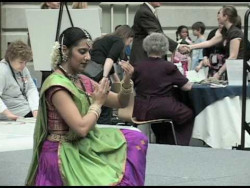
<p>Here is a collection of videos from a Women's History Month family festival, that includes interviews and performance footage with Kathak dancer Prachi Dalal, Native American singing group Ulali, mother-daughter storyteller and artist Yona Zeldis McDonough and Malcah Zeldis, and the Georgia Tech Glee Club paying tribute to the women in the audience for Women's History Month. </p>
Philippa Rappoport
5
We the People: Smithsonian-Montgomery College Faculty Fellowship 2018 Opening Panel Resources
<p>This collection serves as an introduction to the opening panel of the 2018 Smithsonian-Montgomery College Faculty Fellowship Program. This year's theme is “We the People: America’s Grand and Radical Experiment with Democracy.” The title for the opening panel is "The Smithsonian Institution: “A Community of Learning and the Opener of Doors.” <br /><br />Four Smithsonian staff members will present, including Richard Kurin (SI Distinguished Scholar and Ambassador-at-Large, Office of the Secretary), Jessica Johnson (Digital Engagement Producer, National Museum of African American History and Culture), Lisa Sasaki (Director, Smithsonian Asian Pacific American Center), and Chris Wilson (Director, Program in African American Culture, National Museum of American History). Their bios, presentation descriptions, and other resources are included here.<br /><br /><br />#MCteach </p>
Philippa Rappoport
16
"We the People": Flash Card Activity and Template
<p>This collection includes a variety of resources on the theme, "We the People," a template document for teachers to create their own flashcard activity with Learning Lab images, and strategies to use them.</p>
<p>This collection was created for the 2018 cohort of the Smithsonian-Montgomery College Faculty Fellowship Program on the theme, "We the People: America's Grand and Radical Experiment with Democracy." But anyone can use it.</p>
<p>Strategies: Begin by selecting your own set of images. (Feel free to copy this collection and then adapt as you like.) When creating your flashcards, use the template from the last learning tile, and add relevant text diagonally below the object. Print double-sided flipping on the SHORT side.</p>
<p>After distributing the cards, have students select one or two that speak to them. Then have them discuss the following questions in groups and share out.</p>
<p>Supporting Questions:<br />What themes do you see?<br />Do you see these themes across the objects and over time?</p>
<p>Essential Questions:<br />Using these images, define American Democracy.<br />What other resources might you use to tell a fuller story?</p><p><br /></p><p>Keywords: #MCteach</p>
<p><br /></p>
Philippa Rappoport
50

Using Technology to Explore Our Nation’s Difficult Past
<p>This collection serves as a preview for the fifth of six seminar sessions in the 2018 Smithsonian-Montgomery College Faculty Fellowship Program. This year's theme is “We the People: America’s Grand and Radical Experiment with Democracy.”</p>
<p>Kinshasha Holman Conwill, Rex Ellis, Helsynia Brown, Adam Martin, and Jessica Johnson will engage participants in an exploration of the National Museum of African American History and Culture's efforts to use technology to make the museum a participatory environment. A fuller description and presenter bios are included inside the collection.</p>
<p>#MCteach</p>
Philippa Rappoport
9
Using Global Thinking Strategies with Latino Content
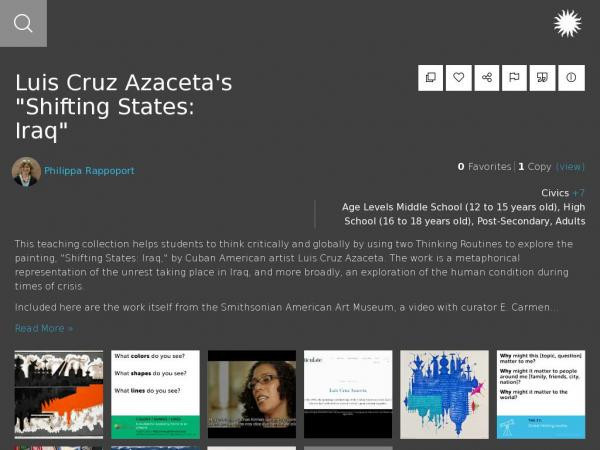
<p>Teachers looking to foster in their students a broader understanding and appreciation of today’s complex world can use these Learning Lab collections that pair Harvard’s Project Zero Global Thinking Routines with new bilingual Latino-content videos of National Portrait Gallery and Smithsonian American Art Museum curators discussing works in the collection. <br /></p>
<p>Each Learning Lab teaching collection includes additional supporting materials to add dimension, expand the activity, and deepen students' learning. <br /></p>
<p>These four videos were created with federal support from the Latino Initiatives Pool, administered by the Smithsonian Latino Center.<br /></p><p>#LatinoHAC<br /></p>
Philippa Rappoport
5
Using Biography and Portraiture to Learn about Asian Pacific American History | Cultivating Learning
<p><span dir="auto">This collection serves as a digital companion to a <em>Cultivating Learning</em> professional development session with Andrea Kim Neighbors, Head of Education at the Smithsonian Asian Pacific American Center (APAC), exploring </span>how biographies and portraits can be used to learn about Asian Pacific American history, art, culture, lived experiences, and more. In the session, participants practice techniques to analyze a portrait from APAC's book, "We Are Here: 30 Inspiring Asian Americans and Pacific Islanders Who Have Shaped the United States," emphasizing the story of tennis star and activist Naomi Osaka. This session focuses on close looking and reflection on how Osaka spoke up about social injustice, the Black Lives Matter movement, and her experiences as a mixed-race woman of Japanese and Haitian descent. Included here are 30 classroom-ready digital activities that can be used with middle and high school students, and strategies to use with portraiture and biography.<br><br>This interactive webinar is part of “Cultivating Learning,” a professional development webinar series focusing on techniques to use digital museum resources for learning. Check out “Cultivating Learning” and other Smithsonian Learning Lab webinars:<a href="https://www.youtube.com/redirect?event=video_description&redir_token=QUFFLUhqbW0tbkVMdEJJcVd0QzRxcEU0QzYyZjh5VEY2d3xBQ3Jtc0trUFVObFlPY0hsWXZxX3c2RWNRVklOdnlrenNrVERXQXZnSTVSQ28tZVVuLU9rSjhLTkdyN3doT2s0RlN0eURHV1lYclB2R0hvNDlUdnU3Zi1xdTdXWnRGajAySzFianJZYUtOY0Qzc3dfSV9GMXZmZw&q=https%3A%2F%2Flearninglab.si.edu%2Fhelp&v=s6WrXnRH2Iw"></a><a href="https://learninglab.si.edu/help">https://learninglab.si.edu/help</a><br></p>
Philippa Rappoport
7
Unsettled Nature: Art and Science as Argument
<p>This collection serves as a preview for the sixth of six seminar sessions in the 2020 Smithsonian-Montgomery College Faculty Fellowship Program. This year's theme is “Humans and the Footprints We Leave: Climate Change and Other Critical Challenges." </p>
<p>Two Smithsonian staff members, Elizabeth Dale-Deines and Joanne Marsh, will discuss content and educational strategies related to the joint exhibition, <em>Unsettled Nature, </em>from the <em></em>Smithsonian American Art Museum and the National Museum of Natural History.<em><br></em></p>
<p>Resources included in this collection have been recommended by the presenters for participants to explore before the seminar itself.<br></p>
<p>#MCteach</p>
Philippa Rappoport
15

Training Workshop for NJ Arts Integration and Cultural Competency Project
<p>This collection includes digital museum resources and replicable activities that will serve as a springboard for discussion during a training with teachers participating in the <em>Arts Integration and Cultural Competency Professional Support for New Jersey Educators</em> project. <br></p>
<p>This collection was co-created with <a href="https://learninglab.si.edu/profile/9">Tess Porter</a>. It was copied and adapted from a collection (included below) by <a href="https://learninglab.si.edu/profile/8">Ashley Naranjo</a>, that was designed to prompt discussion about identity, immigration, "master" or dominant narratives in history, and hero myths. </p>
<p>This program received Federal support from the Asian Pacific American Initiatives Pool, administered by the Smithsonian Asian Pacific American Center.</p>
<p>Keyword: Roger Shimomura<br>#APAArtsIntegration<br></p>
Philippa Rappoport
19
Toward a More Inclusive America through the Arts: Statues of Liberty and other National Symbols
<p>This collection asks students to explore the importance of national symbols to our cultural, political, and collective identity. By examining symbols that are meant to reflect our highest ideals as a nation - the Statue of Liberty, the American flag, the Star Spangled Banner, the Battle Hymn of the Republic, and other cultural artifacts - and their many interpretations, students will consider difficult questions facing us today: Who is included? Who decides? Why and how do people use national symbols as a way to protest? How have our notions and ideals of liberty changed over time?</p>
<p>Included here are </p>
<ul><li>images of the artifacts and supporting objects</li><li>three suggested Thinking Routines - "See, Think, Wonder," "Think, Feel, Care," and "The 3 Ys" - from Harvard's Project Zero Artful and Global Thinking materials<br></li><li>supporting interpretive videos, podcasts, and articles</li><li>a discussion/writing prompt</li></ul>
<p>For use in Social Studies, Spanish, English, Social Studies, Ethnic Studies, and American History classes<br></p>
<p>#EthnicStudies #LatinoHAC </p>
<p></p>
Philippa Rappoport
35
Topical collection for State Education Agency Directors of Arts Education (SEADAE)
<p>This topical collection is designed to introduce SEADAE educators to the Smithsonian Learning Lab and to help them consider a variety of ways to incorporate digital museum content - images, video footage, and learning activities - into their new toolkit for arts educators.</p>
<p>#SEADAE</p>
Philippa Rappoport
36
The William Steinway Diary, 1861-1896: A Unique Perspective on post-Civil War New York
<p>This teaching collection asks students to explore William Steinway’s Diary—which includes diary passages, Steinway family photographs, maps, and advertisements that bring alive the fear and chaos of the 1863 Civil War Draft Riots and his hands-on role in the creation of the New York City subway and the company town of Steinway in modern-day Astoria, Queens - as a jumping off point to understand the second half of the 19th century. Included are two Project Zero Thinking Routines and an Analysis Sheet to help students analyse these primary documents. Students can also expand the activity by researching other historical writings (newspapers, journals, city maps, etc.) from the time period, to gain a deeper understanding of this dynamic period in American history. </p><p>The online exhibition describes: "Over 36 years, nine volumes, and more than 2,500 pages, entries record a newlywed’s exuberance, his observations of a country at war, and his emergence as a leader in the cultural, political, financial, and physical development of New York City. In near-daily entries until his death in 1896, William details the period’s financial panics and labor turmoil, rise of the German immigrant class, growing sophistication of transportation, and fierce piano manufacturing wars in which his family firm, Steinway & Sons, was a major player. A proud member of New York’s German American community, William was at once an immigrant success story and an ambitious industrialist whose development of the company town of Steinway left a lasting imprint on modern-day Queens."</p><p><br /><br /></p>
Philippa Rappoport
14
The Social Power of Music
<p>This collection serves as a preview for the fourth of six seminar sessions in the 2018 Smithsonian-Montgomery College Faculty Fellowship Program. This year's theme is “We the People: America’s Grand and Radical Experiment with Democracy.” </p>
<p>James Deutsch and Atesh Sonneborn of the Smithsonian Center for Folklife and Cultural Heritage (CFCH) will explore with Fellows the social relevance of music, and how music conveys meaning in our lives. They will also take Fellows on a guided tour of the CFCH collections.</p>
<p>#MCteach</p>
Philippa Rappoport
9
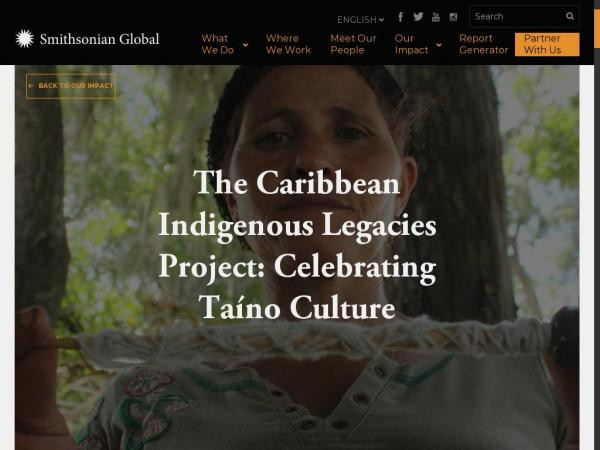
The Smithsonian's Caribbean Indigenous Legacies Project: Celebrating Taíno Culture
<p>This topical collection contains information about the Smithsonian's Caribbean Indigenous Legacies Project: Celebrating Taíno Culture, with links to the Heye Center exhibition, "Taíno : Native Heritage and Identity in the Caribbean," and to a related public program/webcast, "Taíno: A Symposium in Conversation with the Movement," from the National Museum of the American Indian. </p>
<p><a href="https://www.addthis.com/bookmark.php?v=300" class="addthis_button_facebook at300b" title="Facebook"></a><a href="https://www.addthis.com/bookmark.php?v=300" class="addthis_button_twitter at300b" title="Twitter"><span class="at-icon-wrapper"></span></a></p>
<p><a href="https://www.addthis.com/bookmark.php?v=300" class="addthis_button_reddit at300b" target="_blank" title="Reddit"><span class="at-icon-wrapper"></span></a></p>
<p><a href="https://www.addthis.com/bookmark.php?v=300" class="addthis_button_google_plusone_share at300b" target="_blank" title="Google+"><span class="at-icon-wrapper"></span></a></p>
<p><a href="https://www.addthis.com/bookmark.php?v=300" class="addthis_button_google_classroom at300b" target="_blank" title="Google Classroom"><span class="at-icon-wrapper"></span></a></p>
<p><a href="https://www.addthis.com/bookmark.php?v=300" class="addthis_button_pinterest at300b"></a><a href="https://www.addthis.com/bookmark.php?v=300" class="addthis_button_tumblr at300b" target="_blank" title="Tumblr"><span class="at-icon-wrapper"></span></a></p>
<p>
<a href="http://www.addthis.com/bookmark.php?v=300" class="addthis_button_email at300b" target="_blank" title="Email"><span class="at-icon-wrapper"></span></a></p>
Philippa Rappoport
6
The Search for an American Identity: Smithsonian-Montgomery College Faculty Fellowship 2019 Opening Panel Resources
<p>This collection serves as an introduction to the opening panel of the 2019 Smithsonian-Montgomery College Faculty Fellowship Program. This year's theme is “The Search for an American Identity: Building a Nation Together.” Three Smithsonian staff members will present at the opening panel, including David Penney (Associate Director of Research and Scholarship at the National Museum of the American Indian), Ranald Woodaman (Director of Exhibitions and Public Programs at the Smithsonian Latino Center), and Paula Johnson (Curator at the National Museum of American History). Their bios, presentation descriptions, and other resources are included inside.</p><p>As you explore the resources be sure to jot down any questions you may have for the presenters. </p><p>It's going to be a great seminar series!<br /><br /><br />#MCteach</p>
Philippa Rappoport
17
The Native American Struggle for Treaty Rights and Tribal Sovereignty
<p>This collection serves as a preview for the sixth (final) of six seminar sessions in the 2018 Smithsonian-Montgomery College Faculty Fellowship Program. This year's theme is “We the People: America’s Grand and Radical Experiment with Democracy.”<br /></p>
<p>National Museum of American Indian colleagues Mark Hirsch, David Penney, and Colleen Call Smith will explore the past, present, and future of treaties between the United States and Native nations, and show how American Indians have drawn on these 18th- and 19th -century agreements to defend tribal rights and exercise political sovereignty in the 20th and 21st centuries.<span class="Apple-converted-space"> They will also discuss their efforts to integrate the exhibition's main themes and messages into the</span> museum’s “Native Knowledge 360°” initiative, a national educational program designed to change the way American Indian histories, cultures, and contemporary lives are taught in K-12 classrooms.</p>
<p>Resources included in this collection have been chosen by the presenters for participants to explore before the seminar itself.</p>
<p>#MCteach</p>
Philippa Rappoport
8
The Democratization of Portraiture: Prints and Drawings of all the People by the People
<p>This collection serves as a preview for the first seminar session of the 2018 Smithsonian-Montgomery College Faculty Fellowship Program. This year's theme is “We the People: America’s Grand and Radical Experiment with Democracy.” </p>
<p>National Portrait Gallery curator Asma Naeem and educator Briana Zavadil White will present an engaging and interactive examination of the democratization of portraiture in the United States, and model close looking techniques that Fellows can use with their students. Included within are a presentation description, participant bios, a "reading portraiture" guide, and images and articles for participants to consider in advance of the session.</p>
<p>#MCteach</p>
<p>Christopher Columbus, Yarrow Mamout, Charles Mingus, Lena Horne, Leonard Roy Harmon, Bill Viola</p>
<p><br /></p>
Philippa Rappoport
10
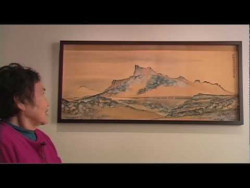
The Art of Gaman: Storytelling, Musical and Dance Performance, and Hands-On Activities Demonstrations
<p>This collection comes from an Asian Pacific American Heritage Month family day in the Grand Salon of the Renwick Gallery of Art. The festival was created to complement the Renwick exhibition, "The Art of Gaman: Arts and Crafts from the Japanese American Internment Camps, 1942-1946." Included here are an interview with the curator of the exhibition, as well as musical and dance performances by Nen Daiko and the Kikuyuki Dancers of America, storytelling and an interview with Anne Shimojima, and hands-on origami and doll-making demonstrations.</p>
Philippa Rappoport
10
Teaching with the Smithsonian Learning Lab: A Workshop for George Washington University Faculty and Graduate Students
<p>For the
workshop, <strong><em>Teaching
with the Smithsonian’s Learning Lab – Millions of Resources at Your
Fingertips! </em><strong>(January 8, 2020),</strong> </strong>this is <em>a </em>collection of
digital museum resources and instructional strategies. It includes a
warm-up activity, a close-looking exercise, and supporting materials for
participants to create their own teaching collections. </p>
<p>This collection was co-created with <a href="https://learninglab.si.edu/profile/9">Tess Porter</a>. </p><p>#GWTeach</p>
Philippa Rappoport
45
Teaching for Community without a Classroom: Leveraging Digital Museum Resources for Distance Learning
<p>This collection serves as a companion resource for the Community Works Institute conference series, <em>Teaching for Community without a Classroom. </em></p>
<p>The session will introduce participants to the Smithsonian Learning Lab, a free platform that gives users access to millions of digital resources from across the Smithsonian and beyond, as well as the tools to create interactive learning experiences with them. This session will also include an activity exploring Luis Cruz Azaceta's "Shifting States: Iraq" to help students think critically and globally, as well as techniques to consider personal experiences and their connection to museum resources.</p>
<p>Included here are an image of the work from the Smithsonian American Art Museum, an explanatory video with curator E. Carmen Ramos, two Thinking Routines - "See, Think, Wonder" and "The 3 Y's" - from Harvard's Project Zero Visible Thinking and Global Thinking materials, examples of activities using museum objects and personal stories, and supporting materials. This collection is adapted from a larger teaching collection on the same theme (Luis Cruz Azaceta's "Shifting States: Iraq" ( <a href="http://learninglab.si.edu/q/ll-c/mBWHa8fHUy9vJsE5">http://learninglab.si.edu/q/ll...</a>), that includes extension activities. </p>
<p>This collection was co-created with <a href="https://learninglab.si.edu/profile/30415">Matthew Decker</a>, <a href="https://learninglab.si.edu/profile/263">Jamie Gillan</a>, and <a href="https://learninglab.si.edu/profile/9" target="_blank">Tess Porter</a>. </p>
<p>Keywords: #CommunityInVirtualEd, #LatinoHAC, Latinx, Latino, global competency, competencies, CWI, 3ys</p>
Philippa Rappoport
24
Teaching African American History: Acts of Resistance | Cultivating Learning
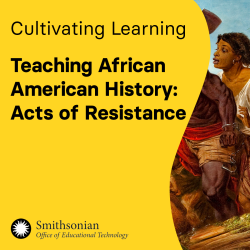
<p><span dir="auto">This collection is a digital companion to a <em>Cultivating Learning</em> professional development session with Candra Flanagan, Lead for Teaching and Learning at the National Museum of African American History and Culture. </span>The session explores an expanding set of free digital materials on African American history, “North Star: A Digital Journey.” </p>
<p>Designed for grades 6–12, the set features stories and throughlines from the museum’s permanent exhibitions. Using images, documents, videos, and checks for understanding, students and their adults can investigate and think critically about history. </p>
<p>The session focuses on individual and community resistance. Participants will gain content knowledge applicable to teaching about slavery in the U.S. context as well as familiarity with the free online resources of “North Star: A Digital Journey.”<br></p>
<p>This interactive webinar is part of “Cultivating Learning,” a professional development webinar series focusing on techniques to use digital museum resources for learning. Check out “Cultivating Learning” and other Smithsonian Learning Lab webinars: <a href="https://www.youtube.com/redirect?event=video_description&redir_token=QUFFLUhqbW0tbkVMdEJJcVd0QzRxcEU0QzYyZjh5VEY2d3xBQ3Jtc0trUFVObFlPY0hsWXZxX3c2RWNRVklOdnlrenNrVERXQXZnSTVSQ28tZVVuLU9rSjhLTkdyN3doT2s0RlN0eURHV1lYclB2R0hvNDlUdnU3Zi1xdTdXWnRGajAySzFianJZYUtOY0Qzc3dfSV9GMXZmZw&q=https%3A%2F%2Flearninglab.si.edu%2Fhelp&v=s6WrXnRH2Iw"></a><a href="https://learninglab.si.edu/help">https://learninglab.si.edu/help</a>.</p>
Philippa Rappoport
14
Supporting Positive Identity Development with Museum Objects | Cultivating Learning
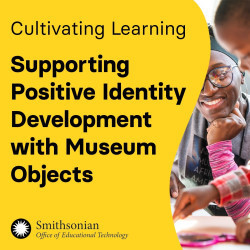
<p><span dir="auto">This collection serves as a digital companion to a <em>Cultivating Learning</em> professional development session with Anna Hindley (Director), and Ariel Moon (LeadEducation Specialist) of the </span>Early Childhood Education Initiative (ECEI) at the National Museum of African American History and Culture. At ECEI, celebration and affirmation are at the foundation of early conversations about history, culture and identity with children. In this session, Anna and Ariel show how museum objects can be used to create joyful and empowering learning experiences for preschool through 2nd-grade students. They share NMAAHC Kids’ <em>Joyful ABCs</em> online resource collection for use in participants’ classrooms. Based on the book, <em>A is for All The Things You Are</em> by Anna Hindley, this series of activity books and videos uses museum objects and stories of Black history and culture to support all children to express and love themselves. The session focuses on supporting educators to use developmentally appropriate strategies for beginning these important conversations and lessons by utilizing the Joyful ABCs series resources.<br><br>This interactive webinar is part of “Cultivating Learning,” a professional development webinar series focusing on techniques to use digital museum resources for learning. Check out “Cultivating Learning” and other Smithsonian Learning Lab webinars: <a href="https://www.youtube.com/redirect?event=video_description&redir_token=QUFFLUhqbW0tbkVMdEJJcVd0QzRxcEU0QzYyZjh5VEY2d3xBQ3Jtc0trUFVObFlPY0hsWXZxX3c2RWNRVklOdnlrenNrVERXQXZnSTVSQ28tZVVuLU9rSjhLTkdyN3doT2s0RlN0eURHV1lYclB2R0hvNDlUdnU3Zi1xdTdXWnRGajAySzFianJZYUtOY0Qzc3dfSV9GMXZmZw&q=https%3A%2F%2Flearninglab.si.edu%2Fhelp&v=s6WrXnRH2Iw"></a><a href="https://learninglab.si.edu/help">https://learninglab.si.edu/help</a>.<span dir="auto"> </span></p>
Philippa Rappoport
9
Student Activity: Looking at the Holocaust through Art
<p>This student activity explores the Holocaust through art - three sculptures and one photograph of an artwork, with additional references to give historical context . Using two of Harvard's Project Zero Thinking Routines, students take a deeper dive into the material through guided looking and by considering the significance of the Holocaust personally, to the country and to the world.</p>
Philippa Rappoport
10
Student Activity: Exploring Luis Cruz Azaceta's "Shifting States: Iraq"
<p>This student activity explores Luis Cruz Azaceta's "Shifting States: Iraq" using two Project Zero Thinking Routines to help students think critically and globally. The work is a metaphorical representation of the unrest taking place in Iraq, and more broadly, an exploration of the human condition during times of crisis.</p>
<p>Included here are an image of the work from the Smithsonian American Art Museum, an explanatory video with curator E. Carmen Ramos, two Thinking Routines - "See, Think, Wonder" and "The 3 Y's" - from Harvard's Project Zero Visible Thinking and Global Thinking materials, an array of prompts and Learning Lab tools, and an assignment. This collection is adapted from a larger teaching collection on the same theme (Luis Cruz Azaceta's "Shifting States: Iraq" ( <a href="http://learninglab.si.edu/q/ll-c/mBWHa8fHUy9vJsE5">http://learninglab.si.edu/q/ll...</a>), that includes extension activities. </p>
<p><br></p>
<p>Keywords: #LatinoHAC, Latinx, Latino, global competency, competencies</p>
Philippa Rappoport
12