
Gillian Edwards's collections
Tlingit People and Their Culture
<p>By Rosita Worl (Tlingit), 2009<br></p>
<p><strong>Sea, Land, Rivers</strong></p>
<p><em>Lingít haa sateeyí</em>, "we who are Tlingit," have owned and occupied southeast Alaska since time immemorial. When we say <em>haa aaní</em>, “our land,” we are speaking from the heart. Those words mean ownership, which we have had to defend through history. They mean identity, because this is our homeland. They mean the nourishment of body and spirit provided by bountiful rain forests, coasts and rivers. This land and its gifts have sustained us for hundreds of generations.</p>
<p>We believe that animals are our ancestors. Each matrilineal clan has its ancient progenitors. I am an Eagle from the Thunderbird clan, of the House Lowered from the Sun in Klukwan. I am proud to be a child of the <em>Lukaa<u>x</u>.ádi</em>, or Sockeye, my father’s clan. The history of our lineages is portrayed by images of ancestral animals and by origin stories, ceremonial regalia, dances, songs and names. These things represent <em>at.óow</em>, or “crest” beings, to which each clan has exclusive rights. Mountains, glaciers and other places on the land are also <em>at.óow</em>, because they are linked to incidents in the birth of our people. For a Tlingit person <em>at.óow</em> embody history, ancestry, geography, social being and sacred connection. They symbolize who we are.</p>
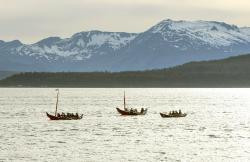
<p>The Tlingit homeland extends from Icy Bay in the north to Prince of Wales Island in the south, some four hundred miles along Alaska’s panhandle. The population is about ten thousand, distributed among a dozen villages, cities and towns. The ocean spreads out before us, with a maze of wooded islands, fjords and channels that Tlingit seafarers historically traveled in cedar-trunk canoes. Behind us are high glaciated mountain ranges that extend inland from the coast.</p>
<p>Fish, especially salmon, is the most important and bountiful resource in the Tlingit region. Harvested in summer and fall and preserved by smoking and drying, it allowed the historical population to grow large, to live in permanent winter villages and to produce surpluses for trade. It is still the year-round staple of our diet. The winter is long, and we look forward to spring and to herring eggs. We pick spring greens as they come up. Through the summer people gather berries and put them away. Summer is the season for hunting seals, which are important both for meat and for their fat. Nutritionists note the exceptional quality of our traditional diet, which includes omega-3 fatty acids found in salmon, cancer-preventing antioxidants in blueberries, and the rich vitamins and proteins of wild meats and fish. We’ve always enjoyed the health benefits and superb tastes of those foods.</p>
<p><strong>Community and Family</strong></p>
<p>Tlingit are divided into opposing and complementary halves, Eagle and Raven, which are called moieties. Each moiety is composed of large extended families that we identify as clans. The clans, in turn, are divided into tribal houses. In the present day, many Tlingit people introduce themselves to others first by personal name and moiety—Eagle or Raven—and then by clan name and house. We inherit clan membership from our mothers but call ourselves the “children” of our father’s clan. In the past, children lived in the house of their father. But when a boy reached the age of ten, he went to live with his mother’s brother, who assumed responsibility for the schooling of his young nephew. A girl remained in her father’s clan house until she married.</p>
<p>Although locally organized by village and clan, our region was never politically unified until coming into conflict with the West. When the Treaty of Cession was signed in 1867 our great-grandparents were astonished to learn that Russia had purported to sell Alaska, including our aboriginal lands, to the United States. Tribal leaders sent a lawyer to Washington to tell the government, “If you want to buy Alaska, then buy it from us, its rightful owners.” The struggle for our land continued for more than a century. The Central Council of Tlingit and Haida Tribes, established during World War II, litigated for thirty years to reach a financial settlement over tribal property taken by the U.S. federal government to create the Tongass National Forest. In 1968, the Tlingit and other groups unified under the Alaska Federation of Natives to pursue both state and federal claims.</p>
<p>The Tlingit people, like all Alaska Natives, endured a long, hard fight for their civil rights. We were denied U.S. citizenship until 1922 and experienced decades of overt discrimination and segregation. Alaska’s own “Jim Crow” laws excluded us from stores, jobs, schools and public buildings. In 1945, the Alaska Native Brotherhood and Alaska Native Sisterhood, based in southeast Alaska, finally won the repeal of discriminatory laws by the state legislature. To earn his Certificate of Citizenship, my grandfather had to pass an English-language and civics test administered by white schoolteachers and then have his application approved by a judge. To practice his rights as a citizen, including the right to vote, he was forced to show that he had given up his Native language and culture to lead a “civilized” life.</p>
<p>When he was dying my grandfather called me to his bedside. I was fourteen years old. He said, “I want you to build a fire in the clan house.” What he was saying is that my generation had to rekindle the fire of our culture and language. That became our responsibility. We have worked hard to help restore cultural knowledge, practice, pride and fluency among our people. We have had substantial success, as witnessed by the huge public expression of our cultures that takes place every other year during the regional Celebration gathering. Progress has been made with the Tlingit language as well, although I don’t know that we’ll ever speak it the way our ancestors did. I will tell you, though, that the voices of our ancestors will always be heard in our land. And our core cultural values will be maintained.</p>
<p><strong>Ceremony and Celebration</strong></p>
<p>One of our strongest values is the maintenance of social and spiritual balance between Eagle and Raven clans to ensure the well-being of society. In addition, we have spiritual obligations to ancestors and future generations, a concept of cultural perpetuation called <em>haa shagoon</em>. These traditional beliefs form the basis of ceremonies called <em><u>k</u>u.éex’</em> or potlatch in English. The most significant <em><u>k</u>u.éex’</em> ceremonies are memorials to those who have passed away. When someone of an Eagle clan dies, members of Raven clans come to assist the grieving relatives. They bring food, contribute to the funeral expenses and sit with the body through the night.</p>
<p>A year after the death the Eagle clan hosts a <em><u>k</u>u.éex’</em> for the Ravens, who come as guests. The hosts display their clan treasures, or <em>at.óow</em>. In this context, the word <em>at.óow</em> refers to works of traditional art that bear the images of crest beings. They include Chilkat blankets woven from dyed mountain sheep wool, button blankets, headdresses, carved and painted boxes, masks and drums. Clan ownership of these crest objects is revalidated by their presentation in the memorial ceremony, accompanied by a recounting of their histories and the origin stories of the crests themselves. Balance is maintained through the response of the Raven clans by presenting their own <em>at.óow</em>. The Eagle clan repays the Ravens, who came to the Eagles’ assistance, by distributing gifts and acknowledging them in oratory and song.</p>
<p>At a memorial <em>ku.éex’</em> we name and honor the deceased person, our ancestors and others in the clan who have recently died. We feed these ancestors and departed relatives with their favorite foods, perhaps smoked cockles, gumboots (chitons) or deer meat. We transfer the food to the spirit world by fire or by giving it to the opposite side to eat.</p>
<p>If the person who died was a clan leader, his successor is named and assumes office at the time of the memorial ceremony. Therefore, a <em>ku.éex’</em> has multiple functions: repaying the opposite moiety and reuniting with them, fulfilling spiritual obligations, and conducting legal and political affairs. This institution, which remains so vital and important in our contemporary lives, is far more complex than a stereotypical understanding of the word potlatch might imply.</p>
<p>Note: This is shortened version of a longer essay from the Smithsonian book <em>Living Our Cultures, Sharing Our Heritage: The First Peoples of Alaska</em>.</p>
<hr>
<p>Tags: Tlingit, Alaska Native, Indigenous, Smithsonian Arctic Studies Center in Alaska (#arcticstudies)</p>
<p></p>
 Gillian Edwards
17
Haida People and Their Culture
<p>By Jeane Breinig (Haida), 2009
<br></p>
<p><strong>Sea, Land, Rivers</strong></p>
<p>It’s an endless cycle – gathering food, putting it up, sharing it among the people. Subsistence is fundamental to our being, even for city-dwellers. Every summer since the kids were little, we would return to Kasaan to join in harvesting activities with family and friends. Our traditions pass on through the foods, the seasons and the generations. I am Haida <em>Yáahl-Xúuts </em>(Raven–Brown Bear), of the <em>Taslaanas</em> clan (The Sandy Beach People) at Kasaan, Alaska. By the custom of our matrilineal society, I trace my descent and clan affiliation through my mother, her mother and a long line of Raven women going back through the centuries.</p>
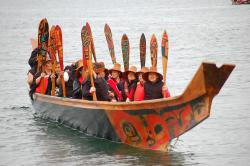
<p>Haida identities are linked to the history of our people. Alaskan Haida look south to Haida Gwaii (Queen Charlotte Islands, Canada) as their ancestral homeland. The present villages of Masset and Skidegate were the only settlements that remained after a smallpox epidemic ravaged Haida Gwaii in 1862. Survivors from at least seventeen other communities found refuge there. Alaskan Haida are the descendants of emigrants who left Haida Gwaii sometime before European contact. Residents of Old Kasaan, one of the original Alaskan villages, moved to (New) Kasaan in 1902, and people from Howkan, Klinkwan, and other early Alaskan Haida settlements consolidated at Hydaburg in 1911. The distance from northern Haida Gwaii to Prince of Wales Island is not great, only about thirty-five miles. It is easy to imagine our forebears going across in their canoes: the Haida are justly famous as seafarers and boat builders. Our red-cedar canoes, some large enough to carry forty passengers, traveled up and down the coasts of Alaska and British Columbia and were sought in trade by Tlingit, Tsimshian and other peoples.</p>
<p>When the salmon start jumping in Kasaan Bay, it’s time to begin gathering the foods of our land. We pick <em>s<u>g</u>hiw</em> (black seaweed) during the minus tides of May, when you can get out to the rocks where it grows. They spread it out on flat rocks to dry in the sun, took it home in gunnysacks, ground it up, and stored it as a savory food for winter. We love to eat it by the handful or sprinkle it on fish soup. As the summer goes on we fish for halibut and the different species of salmon that arrive in our waters. Sockeye from the Karta River, a staple of the diet in Kasaan, are smoked and preserved using an endless variety of family recipes. Clams, abalone, “gumboots” (chitons), crabs and shrimp are also harvested, and salmonberries, blueberries and huckleberries are picked as they ripen in succession. The men go deer hunting in the fall. Another staple is hooligan (eulachon) oil or “grease,” called <em>satáw</em> in the Haida language. Haida traditionally bartered for fish grease and soapberries from the Tsimshian in exchange for our dried seaweed and halibut. That kind of trading still goes on at the annual Alaska Federation of Natives convention every October, when everyone brings specialties from home to exchange for favorite foods from other places.</p>
<p><strong>Family and Community</strong></p>
<p>In a traditional Haida village, cedar-plank longhouses stood side by side, each paired with a tall pole displaying the crest animals of the clan members who resided there. An opening through base of the pole, representing the mouth or stomach of the lowest crest figure, served as the doorway to some houses. Like other southeast Alaskan peoples, the Haida are socially divided between Ravens and Eagles, each half (moiety) composed of numerous matrilineal clans. Traditional marriages were always between a member of a Raven clan and a member of an Eagle clan. The residents of a longhouse included multiple generations of male clan members and women of other clans who came there to live with their husbands.</p>
<p>Much of a child’s education was the responsibility of clan mentors outside the nuclear family: for a boy, this was his maternal uncle, and for a girl, her maternal aunt. On their pathways to adulthood, children received the names of ancestors, as well as piercings and tattoos that signified their clan and rank. Children still learn through watching and participating in the activities of the community. Our oral tradition is another participatory way of learning. Elders teach through stories, although the message may be indirect. If you seek an elder’s counsel, you might hear a tale about another place and time. It is up to you to think about the meaning and apply it to your own life.</p>
<p>The worst horrors of Haida contact with the West were waves of epidemic disease – smallpox, influenza, tuberculosis, whooping cough and others – that consumed the aboriginal population, unchecked by natural immunity. Perhaps fourteen thousand Haida in the 1780s had withered to six hundred by 1915. It is hard to imagine loss on that scale, not only of life, but also of culture and heritage. Most of the clan leadership was gone, and consolidation of the widespread population into just a few villages almost destroyed the complex social system as it had functioned until then.</p>
<p>Haida oral literature is renowned for its epic tales of battles and migrations, transformations from animals to human beings and vice versa, and journeys to spirit worlds in the sky and underwater. Other Haida tales, especially Raven stories, are simply fun with a touch of mystery. Raven, the comical trickster is always in trouble. Elders say that he turned black by getting stuck in the smoke hole of a house and being too fat and lazy to escape.</p>
<p>Today there are fewer than a dozen fluent Alaskan Haida speakers. I am fortunate that my mother, Julie Coburn, is one of them. Her Haida name is <em>Wahlgidouk</em>, “Giver of Gifts,” meaning a person who brings in presents to be distributed at a ceremonial giveaway, or potlatch. She has been giving the gifts of language and literature throughout her life. Keeping her language was a kind of heroism under all the pressures for acculturation. Her parents, concerned about their children’s survival in Western culture, spoke Haida to them at home but asked them to answer in English. At her boarding school in Sitka, speaking Haida was harshly punished. But as an adult in her fifties, she recognized that the language was fading away, so she relearned it and now has had the good fortune also to teach others. She participated in the Haida Society for the Preservation of Haida Language and Literature and contributed to work accomplished at the Alaska Native Language Center when Haida elders developed a standardized writing system.</p>
<p><strong>Ceremony and Celebration</strong></p>
<p>In 1880, Chief Son-I-Hat built <em>Neyúwens</em> ("Great House") near Kasaan Bay, a mile from the location where New Kasaan was later founded. That structure, today called the Whale House, was restored in 1938 by Haida craftsmen working for the Civilian Conservation Corps. The restoration included the house’s crest pole and carved interior posts, which portray <em>Coon-Ahts</em>, a legendary figure who captured the monster <em>Gonaqadate</em> and put on his skin to hunt whales. Surrounding the house are additional totem poles brought over from Old Kasaan and restored, along with copies of several more. The Whale House is the only surviving traditional Haida clan house in Alaska.</p>
<p>The English word potlatch has been used for traditional Haida ceremonies that centered on feasting, dancing and the distribution of property by chiefs and other leaders. The Haida word is <em>'wáahlaal</em>. The largest potlatches marked the completion of a new clan house or the death of a chief and succession of his heir. Chief Son-I-Hat, one of the wealthiest Haida leaders, hosted numerous potlatches before his death in 1912. Potlatches were outlawed by the Canadian government in 1884, and they were discouraged by Christian missionaries who came to the Haida region in the 1870s and 1880s.</p>
<p>Despite attempts to suppress of our traditional ceremonies, we still hold feasts and memorial potlatches, but now in transformed ways. Traditionally, potlatches represented a time for the deceased person’s clan to repay those from other clans who had helped them at the time of the death. In many respects, a potlatch can be viewed as a social occasion but with very formal aspects, acknowledging the sadness of the loss but also marking the end of mourning. Potlatches are also the time to repay those who have served as witnesses for naming ceremonies. By accepting a gift, recipients acknowledge that the name is legally granted within the traditional Haida system.</p>
<p>We are celebrating and revitalizing Haida culture in southeast Alaska. Teaching the language and rebuilding the Whale House are just a part of it. Every summer in Kasaan, a culture camp for the kids is held, with storytelling, dancing and subsistence activities. They want to learn and are so proud of their heritage. What does it mean to be Haida? The answer now is different from that of the past, obviously. We need to know our history and learn from it. We need to know our culture and draw strength from it. We need to make it work for us today.</p>
<p>Note: This is shortened version of a longer essay from the Smithsonian book <em>Living Our Cultures, Sharing Our Heritage: The First Peoples of Alaska</em>.</p>
<hr>
<p>Tags: Haida, Alaska Native, Indigenous, Smithsonian Arctic Studies Center in Alaska (#arcticstudies)</p>
Gillian Edwards
17
Tsimshian People and Their Culture
<p><strong>The Tsimshian People and Their Culture</strong></p>
<p>By David Boxley (Tsimshian), 2009
<br></p>
<p><strong><strong>Land, Sea, Rivers</strong></strong></p>
<p>Most Tsimshian live along the coast of northern British Columbia between the Nass River and Queen Charlotte Sound. The shores and islands are covered by northern rain forests of hemlock, spruce, fir, red cedar and yellow cedar, woods that were the basic raw materials of our culture. Tsimshian territory extends into the mountainous interior as well, following the valley of the Skeena River.</p>
<p>At one time at least eight thousand Tsimshian lived there, located in twenty winter villages and many seasonal camps. Today about thirty-five hundred live in seven Canadian towns. In 1862, a Tsimshian group led by an Anglican missionary, William Duncan, broke away from Fort Simpson to found a religious colony at Old Metlakatla. Twenty-five years later they moved again, building New Metlakatla on Annette Island, in southeast Alaska. Generations have lived there since, and that is the community in which I was born and grew up. I was very fortunate to be raised by my grandfather and grandmother, Albert and Dora Bolton, who gave me a strong foundation in our culture. When I was young they took me with them to their fish camps and on trips all over our island for subsistence activities.</p>
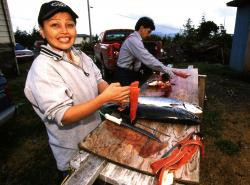
<p>Most people still rely a great deal on fish, seals, berries and other traditional foods, supplemented by commercial fishing and other sources of cash income. In historical times, the year’s food gathering began in spring when the ice broke up on the Nass River and the eulachon began running there. People traveled from their winter villages to harvest the fish in nets, drying some and fermenting and boiling the rest to extract the oil. Trade in eulachon grease, which no other people could produce in such quantity, was one of the sources of Tsimshian wealth and prosperity. In spring they also gathered seaweed and herring eggs, fished for halibut, and collected bird eggs and abalone. During summer and fall they relocated to fishing sites on the rivers to catch salmon with weirs and traps, drying and smoking them for winter. At the winter villages they gathered clams, cockles and mussels, and if you visit those old settlements today you can still see the mounds of discarded shells. At different times of the year they hunted seals, sea lions, deer, elk, mountain goats and mountain sheep.</p>
<p>Archaeological sites in Prince Rupert Harbour demonstrate that this way of life goes back at least five thousand years. Crest objects such as chiefs’ headdresses and masks are connected to origin stories and to the succession of clan leaders who have owned and passed them down to their descendants, along with name titles and titles to land. This is important in British Columbia where the Tsimshian Nation is attempting to reclaim territories that were taken by the Canadian government in the 1870s. Crest objects and the histories attached to them validate those aboriginal claims and link the people to specific places on the land where they lived and harvested food in the old days.</p>
<p><strong>Family and Community</strong></p>
<p>My people are divided into four equal groups. Each is a <em>pteex</em> (clan) with its own principal crest: Eagle (<em>Laxsgiik</em>), Raven (<em>Ganhada</em>), Wolf (<em>Laxgibuu</em>), and Killer Whale (<em>Gisbutwada</em>). Crests are symbols of matrilineal connection, so whatever <em>pteex</em> your mother comes from, you will be the same. Because clans marry out, your father will be from a different one of the four. Within each <em>pteex</em> are multiple lineages, like branches on a family tree. Eagle, Raven, Wolf, and Killer Whale each have as many as twenty-five subcrests, a few available that are to everyone in the clan and the rest limited to certain branches. As a <em>Laxsgiik</em>, I may use the Eagle, Beaver, and Halibut crests; I inherited other, more restricted crests from my close maternal ancestors.</p>
<p>Crests represent social identity and its corresponding rights and privileges. Crest images appear on robes, button blankets, headdresses and other regalia that people wear at potlatches to show their ancestry. They are shown on ceremonial drums, staffs and rattles; on dishes and ladles used for serving food at potlatch feasts; and on the totem poles, house fronts, posts and screens of traditional lineage houses.</p>
<p>If you could go back in time to visit a coastal Tsimshian village of two centuries ago, you would see our social system at work. The community is built along the shore, with palisades around back to guard against possible attack from land. You arrive by canoe and announce your person and business while still afloat, waiting for permission to land. Jumping ashore without proper protocol would have been life threatening in those days. Coming up from the beach in the company of your hosts, you see the big red-cedar longhouses, lined up in a row with their doorways facing the water. Each is home to thirty or forty people, most of them matrilineal relatives but including wives and children of other clans.</p>
<p>The village chief’s house is the largest and is located in a central position. Its painted front panels show his crests. The other dwellings are positioned in relation to the chief’s house according to the social ranking of their household heads. In front of prestigious homes are totem poles, carved with crest emblems and figures. Poles are sculptural narratives, telling who lives in a house, the ancient origin and recent history of their lineage, and the achievements of their deceased chiefs and nobles.</p>
<p>Entering one of the longhouses requires that you stoop down to pass through a low door, a vulnerable position for any would-be attacker. Depending on the status of the house, the interior is lined with one or more levels of wood-planked sleeping platforms, like wide bleachers that step down to the central fire pit. The platforms are divided into family living areas, cordoned off with mats or boards. The house chief and his family have a private apartment at the far end of the house, behind a carved and painted wooden screen. Inside the house you see lots of preserved food—dried salmon and halibut, bentwood boxes filled with fish oil, seal grease, and berries; containers of dried meat. All of this came from hunting and fishing territories owned by the house members.</p>
<p>The original Tsimshian way of life began to change when British, Spanish and American fur traders arrived in the late 1700s. The Hudson’s Bay Company built Fort Simpson at the mouth of the Nass River in 1831, and missionaries of several Christian denominations came to work among the Tsimshian, Haida and Tlingit people who had gathered near the fort for trade. The missionaries were successful at converting a large part of the population, which was in rapid decline as a result of smallpox and other new diseases. The people gave up their traditional beliefs, ended their ceremonies and even cut down many of the totem poles.</p>
<p>The converts who followed William Duncan from Fort Simpson to Old Metlakatla and then to Alaska were making a new start, trying to survive in a world that was rapidly changing. Now, more than one hundred years later, Metlakatla is a pretty distinctive place. Little about its everyday appearance would remind a visitor of the lifeways of the past, but we are still proudly Tsimshian, with a strong sense of our unique identity. Our language, <em>Sm’Algyax</em>, has changed from the way it is spoken in Canada, and unfortunately Metlakatla has only a few fluent speakers left, all elders. That frightens me, and I’ve been trying very hard to hold on to what I know and to learn more. We are who we are, but we are what our language makes us, too.</p>
<p><strong>Ceremony and Celebration</strong></p>
<p><em>Halaayt</em> is spirit power, which comes from above. It gave chiefs and high-ranking people the knowledge and strength they needed to be leaders and to make good decisions. <em>Halaayt</em> enabled them to be the link between their people and the next world, where our ancestors dwell, and to communicate with the spirits of animals. The frontlet of a chief’s ceremonial headdress was a symbol of his <em>halaayt</em>. The face in the center was a crest, surrounded by abalone, sea lion whiskers, feathers and ermine fur. The chief’s headdress, woven robe and Raven rattle all represented his leadership and spiritual power.</p>
<p>Historically, potlatch feasts celebrated events and transitions in the community – death, marriage, the completion of a new house, the raising of a totem pole, or the settlement of a dispute between clans. The largest and most important of these feasts were memorial potlatches, when new chiefs were installed and took the names of their predecessors. Potlatches have always been based on a whole system of reciprocity. During the feast, hosts of one clan recognize and repay debts that they have incurred through services given to them by people of other clans, who come as guests.</p>
<p>Three things are essential to a potlatch. First, it has to be done publicly. The guests are there to serve as witnesses to what is taking place, and that is what makes it legal. Second, the hosts have to gift every guest in payment for his or her witness. Finally, everyone must be fed and fed very well. More than they need. The food they take home with them is another gift.</p>
<p>In 1982, I set out to organize Metlakatla’s first potlatch. For our community it would be the revival of a tradition that we had left behind over a century before in the historical move to Alaska. Many potlatches have been held in Metlakatla since then, and one of the largest was in 1994. It was originally planned as a celebration of my grandfather’s hundredth birthday, but it became his memorial after he passed away at age ninety-eight. I realized that in order for the potlatch to happen on the scale that I had hoped, it would have to include all four clans. Their involvement not only ensured the amazing success of the event but also paved the way for the future, because so many participated and learned so much. We fed a thousand people every evening, three totem poles were raised, and over fifty-five button robes were dedicated on the first night alone. I feel lucky to have come along when I did, at a time when it was right for these changes to take place. The way I grew up, and the gifts of language and culture that my grandparents gave me, prepared me for the journey.
</p>
<p>Note: This is shortened version of a longer essay from the Smithsonian book <em>Living Our Cultures, Sharing Our Heritage: The First Peoples of Alaska</em>.</p>
<hr>
<p>Tags: Tsimshian Alaska Native, Indigenous, Smithsonian Arctic Studies Center in Alaska (#arcticstudies)</p>
Gillian Edwards
15